Signed in as:
filler@godaddy.com
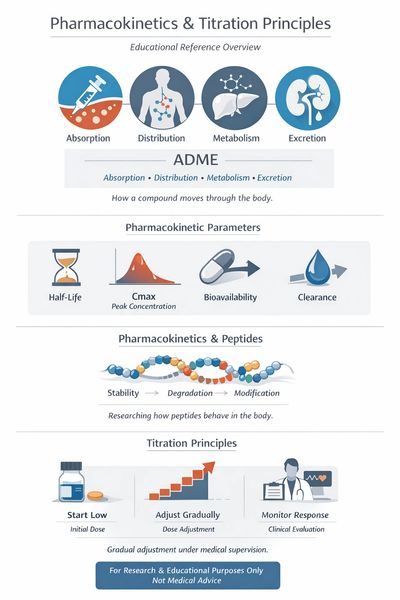
Pharmacokinetics (often abbreviated as PK) is the scientific study of how a substance moves through the body over time. It describes what the body does to a compound after it is administered.
Pharmacokinetics is commonly summarized by four core processes:
Together, these processes determine how quickly a compound enters the body, where it travels, how long it remains present, and how it is eliminated.
Pharmacokinetics does not describe what a compound does biologically. Instead, it describes how the body handles the compound.
Absorption
Absorption refers to how a compound enters the bloodstream after administration. The rate and extent of absorption can vary depending on formulation, molecular structure, and route of administration.
Distribution
Distribution describes how a compound moves from the bloodstream into tissues and organs. Some compounds remain primarily in circulation, while others distribute more extensively into specific tissues.
Metabolism
Metabolism refers to the chemical breakdown of a compound by enzymes, primarily in the liver and other tissues. Metabolic processes convert compounds into metabolites that may be active or inactive.
Excretion
Excretion is the removal of a compound and its metabolites from the body, commonly through the kidneys (urine), bile, or other elimination pathways.
Half-life
Half-life is the time required for the concentration of a compound in the body to decrease by approximately 50 percent. It provides a general indication of how long a compound persists in systemic circulation.
Bioavailability
Bioavailability describes the proportion of an administered compound that reaches systemic circulation in an unchanged form.
Peak Concentration (Cmax)
Cmax refers to the highest measured concentration of a compound in the bloodstream after administration.
Time to Peak Concentration (Tmax)
Tmax is the time it takes to reach peak concentration.
Clearance
Clearance represents the body’s ability to eliminate a compound over time.
These parameters are typically determined in controlled laboratory, animal, or clinical research settings.
Peptides are chains of amino acids that are generally broken down in the body by enzymatic processes. Because of this, peptides often have distinct pharmacokinetic characteristics compared to small-molecule drugs.
In research settings, peptide pharmacokinetics are studied to understand:
Many modern peptides are chemically modified to improve stability, prolong circulation time, or reduce enzymatic breakdown.
Pharmacokinetic data for peptides is generated through pre-clinical and clinical research and is specific to each individual compound.
Titration is a general term describing the process of gradually adjusting the amount of a compound administered over time.
In regulated medical contexts, titration is used to:
Titration does not imply self-adjustment or experimentation. In approved medical use, titration schedules are defined in prescribing information and managed by licensed healthcare professionals.
For investigational compounds, titration concepts may be explored in research protocols but are not established for general use.
Understanding pharmacokinetics helps researchers and clinicians:
Titration principles are informed by pharmacokinetic data but are always applied within structured, regulated frameworks.
Pharmacokinetic data describes how a compound behaves in the body.
It does not determine safety, effectiveness, or suitability for any individual.
Titration principles describe a general medical concept.
They are not instructions for self-use.
This page is provided for informational and educational purposes only.
Nothing on this page constitutes medical advice, diagnosis, or treatment guidance. Pharmacokinetic and titration concepts should be interpreted and applied only by qualified healthcare professionals within appropriate regulatory frameworks.