NYX-GEN BIO
NYX-GEN BIO
  • Home
  • Shop
  • RESEARCH COMPOUNDS
    • Retatrutide
    • Tirzepatide
    • Lemon Bottle
    • GLOW
  • INFORMATION
    • Pharmacokinetics
    • Fat Oxidation Capacity
    • Basel Metabolic Rate
    • Peptide Storage
    • Peptide Reconstitution
  • WEIGHT LOSS
    • Foundation of Weight Loss
    • Hormones & Weight Gain
  • NUTRITION
    • Nutrition on GLP-1 Meds
    • Nausea on GLP-1 Meds
    • Protein Intake
    • GLP-1 & Digestion
  • More
    • Home
    • Shop
    • RESEARCH COMPOUNDS
      • Retatrutide
      • Tirzepatide
      • Lemon Bottle
      • GLOW
    • INFORMATION
      • Pharmacokinetics
      • Fat Oxidation Capacity
      • Basel Metabolic Rate
      • Peptide Storage
      • Peptide Reconstitution
    • WEIGHT LOSS
      • Foundation of Weight Loss
      • Hormones & Weight Gain
    • NUTRITION
      • Nutrition on GLP-1 Meds
      • Nausea on GLP-1 Meds
      • Protein Intake
      • GLP-1 & Digestion
  • Sign In
  • Create Account

  • Orders
  • My Account
  • Signed in as:

  • filler@godaddy.com


  • Orders
  • My Account
  • Sign out

Signed in as:

filler@godaddy.com
  • Home
  • Shop
  • RESEARCH COMPOUNDS
    • Retatrutide
    • Tirzepatide
    • Lemon Bottle
    • GLOW
  • INFORMATION
    • Pharmacokinetics
    • Fat Oxidation Capacity
    • Basel Metabolic Rate
    • Peptide Storage
    • Peptide Reconstitution
  • WEIGHT LOSS
    • Foundation of Weight Loss
    • Hormones & Weight Gain
  • NUTRITION
    • Nutrition on GLP-1 Meds
    • Nausea on GLP-1 Meds
    • Protein Intake
    • GLP-1 & Digestion

Account

  • Orders
  • My Account
  • Sign out

  • Sign In
  • Orders
  • My Account

PEPTIDE STORAGE

Handling & Stability Information

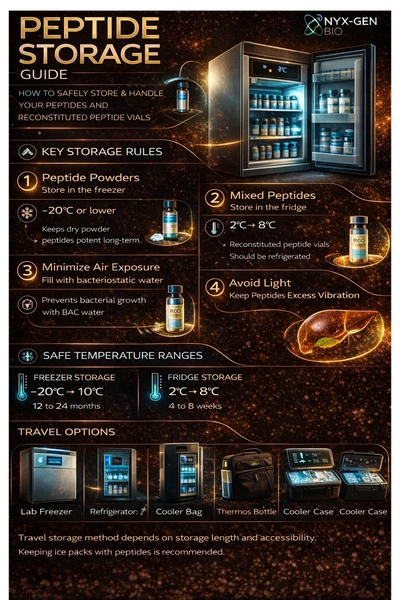
Peptides are delicate biological compounds. Proper storage helps maintain stability and preserve the integrity of the product until it is used or reconstituted.

Understanding how temperature, light, and handling affect peptides can help ensure product quality is maintained.

Why Proper Storage Matters

Peptides are chains of amino acids held together by chemical bonds that can degrade over time if exposed to unfavorable conditions.

Factors that influence peptide stability include:

  • Temperature
  • Light exposure
  • Moisture
  • Repeated handling or contamination
     

Maintaining appropriate storage conditions helps reduce degradation and supports product stability.

Storage Before Reconstitution

Most peptides are supplied in lyophilized (freeze-dried) form.

Lyophilization removes water from the compound, which helps improve stability during storage and transport.

For lyophilized peptides:

  • Store in a cool, dry environment
  • Refrigeration between 2–8°C (36–46°F) is generally recommended
  • Keep vials sealed and protected from light


When stored properly in this form, many peptides maintain stability for extended periods.

Storage After Reconstitution

Once a peptide has been reconstituted with bacteriostatic or sterile water, the compound becomes more sensitive to environmental conditions.

Common storage practices include:

  • Refrigeration at 2–8°C (36–46°F) 
  • Protection from direct light 
  • Minimizing repeated temperature changes
     

Reconstituted solutions are typically more susceptible to degradation than lyophilized powders.

Avoid Temperature Extremes

Peptides should not be exposed to prolonged high temperatures.

Heat can accelerate the breakdown of peptide bonds, reducing stability.

Avoid:

  • Leaving peptides at room temperature for extended periods
  • Storing near heat sources
  • Repeated warming and cooling cycles
     

If refrigeration is available, it is generally preferred.

Protect From Light

Some peptides may degrade when exposed to strong light.

For this reason:

  • Vials are commonly stored in amber glass
  • Packaging is designed to limit light exposure
     

Keeping peptides inside their original packaging or in a dark environment can help maintain stability.

Avoid Repeated Freeze–Thaw Cycles

Repeated freezing and thawing can stress peptide structures and may accelerate degradation.

If freezing is used for long-term storage, minimizing temperature fluctuations helps maintain stability.

General Handling Considerations

To help maintain peptide quality:

  • Keep vials sealed until needed 
  • Handle with clean equipment and surfaces
  • Avoid unnecessary agitation or shaking
     

Proper handling helps reduce contamination and preserves product integrity.

Product Integrity

Peptides are sensitive biological compounds. Even small environmental changes can influence their stability over time.

Following appropriate storage practices helps maintain product quality throughout its intended shelf life.

Important Notice

Products referenced on this website are provided for research and educational purposes only.

Nothing on this page constitutes medical advice, treatment guidance, or instructions for human use.

Copyright © 2026 NXY-GEN BIO - All Rights Reserved.

Powered by

  • Privacy Policy
  • Terms and Conditions

This website uses cookies.

We use cookies to analyze website traffic and optimize your website experience. By accepting our use of cookies, your data will be aggregated with all other user data.

Accept