Signed in as:
filler@godaddy.com
Weight Loss Is a Mass Change, Not a Biological Goal
The body does not possess a built-in objective called “weight loss.”
It regulates energy availability, storage, and survival.
Weight change is a downstream consequence of how those systems interact over time.
This distinction matters, because many frustrations around weight stem from treating weight loss as a direct target rather than as an emergent outcome.
Total body weight is composed of multiple compartments:
The scale aggregates all of them into a single number.
This is why scale changes can occur without meaningful fat loss, and why fat loss can occur without large scale movement.
Weight loss describes a reduction in total mass.
Fat loss describes a reduction in stored adipose tissue.
They are related but not synonymous.
A person can lose weight by:
None of these represent the primary objective of most people seeking body composition improvement.
Fat loss is a specific biological process.
Weight loss is merely one possible signal that fat loss may be occurring.
Regardless of hormonal environment, metabolic health, or pharmacology, the body obeys conservation of energy.
Energy must come from somewhere.
If total energy expenditure exceeds incoming energy over time, internal energy stores supply the difference.
This principle is non-negotiable.
However, how the body supplies that energy is highly negotiable.
That negotiation is where most complexity lives.
The more precise question is:
Which tissues are supplying energy, and which tissues are storing energy?
Energy balance describes direction.
Energy partitioning describes composition.
Two individuals with the same calorie deficit can experience very different proportions of:
Partitioning is influenced by hormones, activity, protein intake, genetics, and metabolic health.
Fat tissue exists because it solves an evolutionary problem.
It provides:
The body is highly efficient at storing energy because historically, food scarcity was a greater threat than food abundance.
Modern environments reverse that pressure.
Biology did not update.
From the body’s perspective, fat loss represents loss of insurance.
As fat mass decreases:
These are protective responses.
They are not moral failures.
They are not lack of discipline.
They are physiology.
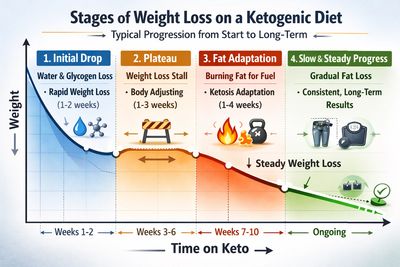
Most people expect a straight downward line.
Biology produces waves.
Short-term fluctuations reflect:
Long-term trends reflect fat mass changes.
Confusing short-term noise with long-term signal is one of the most common sources of frustration.
Sustained changes in intake or expenditure trigger adaptation.
The system seeks a new equilibrium.
This does not mean fat loss becomes impossible.
It means the same strategy produces diminishing returns over time.
Understanding this reframes plateaus as signals, not failures.
It emerges from interactions between:
No single variable explains outcomes in isolation.
Anyone selling a single-variable explanation is simplifying for marketing, not accuracy.
These Compounds Do Not “Burn Fat”
Semaglutide, tirzepatide, and Retatrutide are not fat-burning agents in the classical sense.
Instead, they shift the regulatory environment in which fat loss occurs.
They influence:
Fat loss remains a downstream consequence.
Shared Foundation: Appetite & Satiety Signaling
All three compounds activate the GLP-1 receptor pathway.
GLP-1 signaling is associated with:
Conceptually, this affects fat loss by reducing the probability of chronic overeating.
Not by force.
Not by willpower.
By changing hunger perception.
This shifts average daily intake downward for many individuals.
Lower intake → easier maintenance of energy deficit → higher likelihood of fat loss.
Insulin Modulation & Fat Accessibility
GLP-1–based signaling improves glucose handling and insulin dynamics.
Conceptually, this can:
Lower average insulin exposure favors fat mobilization.
This does not guarantee fat loss.
It improves the conditions under which fat can be accessed.
Think of this as unlocking a door, not forcing fat out.
Semaglutide (GLP-1 Agonist)
Semaglutide primarily influences the input side of the energy equation.
Main conceptual effects:
This primarily acts by:
Less energy in
Semaglutide does not meaningfully increase energy expenditure.
Its fat-loss effect is mostly mediated through reduced intake.
Tirzepatide (GLP-1 + GIP Agonist)
Tirzepatide activates both GLP-1 and GIP receptors.
GIP signaling interacts with:
Conceptually, tirzepatide:
Compared to GLP-1 alone, tirzepatide may:
Still primarily input-side driven. But with broader metabolic modulation.
Retatrutide (GLP-1 + GIP + Glucagon Agonist)
Retatrutide adds a third axis: glucagon receptor activation.
Glucagon signaling is associated with:
Conceptually, Retatrutide influences:
Input side → appetite reduction
Output side → increased energy expenditure and fat utilization
This makes Retatrutide mechanistically distinct.
It is designed to: Reduce energy in while simultaneously increase energy out. This dual-axis design may explain why Retatrutide demonstrates larger average fat loss in clinical research compared to GLP-1–only agents.
Why These Compounds Do Not Create Unlimited Fat Loss
Even with pharmacological assistance:
These compounds shift probabilities, not absolutes.
They tilt the game.
They do not remove the rules.
Unifying Concept
Semaglutide → primarily appetite modulation
Tirzepatide → appetite + insulin/partitioning modulation
Retatrutide → appetite + partitioning + energy expenditure modulation
All three make fat loss more achievable.
None make fat loss automatic.
Foundational Takeaways
Understanding these foundations changes how all other information is interpreted.
Conceptual Takeaway
These peptides do not replace foundational biology.
They reshape the biological environment in which fat loss occurs.
Fat loss remains:
Energy deficit
The drugs influence all three variables indirectly.
This content is provided for informational and educational purposes only.
Nothing on this page constitutes medical advice, diagnosis, or treatment guidance.