Signed in as:
filler@godaddy.com
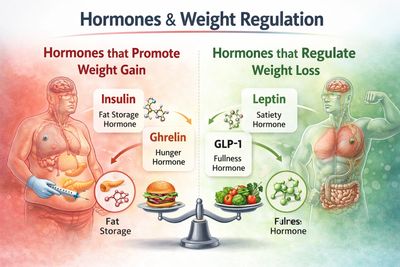
Calories describe quantity of energy.
Hormones largely determine where that energy goes.
Two people can consume similar calories and experience very different outcomes because hormonal signaling influences:
Hormones do not override physics, but they strongly shape how physics expresses itself biologically.
Insulin is not simply a “blood sugar hormone.”
Conceptually, insulin functions as a nutrient storage signal.
When insulin is elevated:
This last point is often underappreciated.
Insulin does not merely encourage fat storage.
It also restricts fat mobilization.
In simplified terms:
High insulin → storage mode
Low insulin → access mode
This does not mean insulin is “bad.”
It means insulin is directional.
Transient insulin rises after eating are normal.
Chronic elevation across much of the day is different.
When insulin remains frequently elevated:
This shifts reliance away from stored fat and toward circulating fuels.
Over long periods, this environment can bias energy partitioning toward storage.
Not instantly.
Not magically.
But gradually.
People often oversimplify:
“High insulin = fat gain.”
Reality is more nuanced.
High insulin permits fat storage.
It does not guarantee it.
Energy still has to be present.
However, high insulin changes probabilities:
Small biases, repeated daily, accumulate.
This is why weight gain is often slow, quiet, and progressive.
When tissues become less responsive to insulin:
This creates a paradoxical situation:
Cells are resistant to insulin’s glucose-lowering effects
but still responsive to insulin’s fat-storage signaling
The body becomes simultaneously:
This combination is metabolically disadvantageous.
Weight regulation emerges from net hormonal tone, not a single hormone.
Insulin interacts with:
The system behaves more like an orchestra than a solo instrument.
Leptin communicates the size of fat stores to the brain.
Higher fat mass → higher leptin
Lower fat mass → lower leptin
In theory, leptin should:
In practice, many individuals develop leptin resistance, where high leptin fails to suppress appetite effectively.
This can coexist with high insulin.
The combination tends to favor continued intake in a storage-biased environment.
GLP-1 and GIP are incretin hormones that influence:
Their relevance to weight regulation is not because they “burn fat,” but because they influence how much energy enters the system and how hunger is perceived.
They operate upstream of energy balance.
Cortisol mobilizes energy during stress.
Chronically elevated cortisol may:
This can indirectly influence fat storage patterns.
Stress physiology and metabolic physiology are tightly linked.
As fat mass decreases:
This is not a flaw.
It is a survival mechanism.
Hormonal adaptation attempts to restore previous energy reserves.
Understanding this explains why:
Weight loss rarely feels linear.
Effort does not always map cleanly to scale change.
This framework explains why weight regulation is complex without resorting to mystical explanations.
Beyond Appetite: Why Glucagon Signaling Matters
Most people associate weight-loss pharmacology with appetite suppression.
Retatrutide is conceptually different because it is studied as a triple-receptor agonist, interacting with:
The glucagon component is particularly important because glucagon signaling is traditionally associated with energy mobilization, not storage.
What Glucagon Normally Does
Glucagon is a hormone released primarily by pancreatic alpha cells.
Key glucagon-associated actions include:
Glucagon shifts the body toward fuel availability rather than fuel storage.
Glucagon Receptor Activation in Metabolic Research
Activation of the glucagon receptor has been studied for its potential to:
Historically, pure glucagon agonism can raise blood glucose, which limits standalone therapeutic use.
Retatrutide’s design pairs glucagon activity with GLP-1 and GIP signaling to balance these effects.
Why Combining Glucagon with GLP-1 and GIP Matters
Conceptually:
The combination aims to:
Reduce energy intake (appetite modulation)
while simultaneously
Increase energy output and fat utilization (glucagon pathway)
This represents a dual-axis approach:
Input side → how much energy enters
Output side → how much energy is expended
Most older agents focus primarily on the input side.
Glucagon Signaling and Fat Accessibility
One of the conceptual bottlenecks in fat loss is not simply having fat stored, but being able to access it.
Glucagon signaling:
This aligns with the idea of increasing fat availability, not just suppressing appetite.
Why This Does Not Bypass Physiology
Glucagon receptor activation does not override:
Instead, it may shift probabilities toward higher fat utilization under certain conditions.
It influences slope, not destiny.
Conceptual Takeaway
Retatrutide is studied not only as an appetite-modulating agent, but as a compound designed to influence both sides of the energy equation:
Less energy in
More energy out
The glucagon component is central to this second half.