Signed in as:
filler@godaddy.com
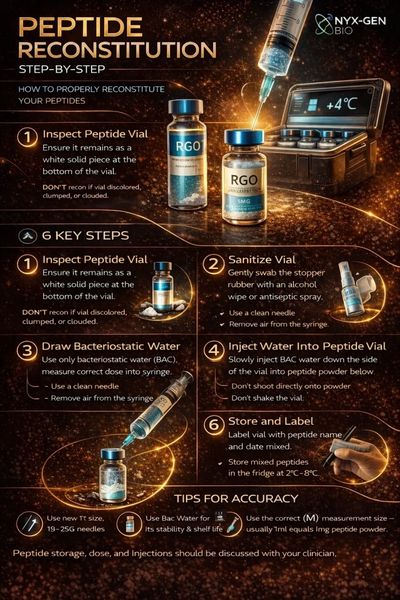
Many peptides are supplied in lyophilized (freeze-dried) form. Before a lyophilized peptide can be used in solution for research purposes, it must first be reconstituted, meaning the dry compound is dissolved in a sterile liquid.
Reconstitution simply restores the peptide from its dry powder form back into a liquid solution.
Lyophilization removes water from the peptide under controlled conditions. This process helps protect the compound during storage and transport.
Benefits of lyophilization include:
Because peptides are sensitive biological molecules, removing moisture significantly improves their stability.
Reconstitution refers to the process of dissolving a lyophilized peptide in a sterile solution so it can exist in liquid form.
The liquid commonly used in research environments may include:
The choice of solvent can depend on the specific peptide and research environment.
Peptides are fragile molecular structures. Improper handling during reconstitution can potentially affect stability.
Important considerations include:
Careful handling helps maintain the integrity of the peptide solution.
Once a peptide has been dissolved into solution, it generally becomes less stable than its freeze-dried form.
Factors that can influence stability include:
For this reason, many peptide solutions are typically stored under refrigeration following reconstitution.
When a peptide is dissolved in a liquid, the result is a solution with a specific concentration.
Concentration refers to how much peptide is present relative to the volume of liquid.
For example:
Understanding concentration is important in laboratory contexts because it determines the relative strength of the solution.
During reconstitution and handling, contamination is one of the most common factors that can reduce peptide stability.
Best practices often include:
Maintaining a clean environment helps preserve solution integrity.
Reconstitution changes how peptides should be stored.
General differences include:
Lyophilized peptide
Reconstituted peptide
Understanding this difference helps preserve product quality.
Products referenced on this website are provided for research and educational purposes only.
This page is intended to explain general scientific concepts related to peptide handling. It does not provide medical advice, treatment guidance, or instructions for human use.
For reconstitution instructions, refer to the specific peptide in the "Research Compounds" tab for further information.